
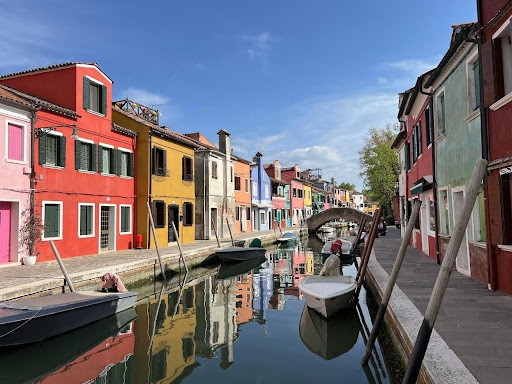
Setting out to explore Venice and the surrounding islands, we heard that Venetians claimed to have Saint Nicholas’s bones. On a Bari tour, Barians said they had the bones. So, who stole Saint Nicholas? Throughout our Italian Sojourn ocean cruise, Saint Nicholas surfaced in stories, churches, and fortresses as we traversed the Adriatic Sea and sailed the Amalfi Coast aboard the Viking Mars. His name echoed through streets, alleyways, and seaside towns, far beyond the legend and precursor to Santa Claus. His deep faith in God, love for children, and concern for sailors led him to use his inheritance generously. He protected the vulnerable and helped those in need. Today, both believers and skeptics share a devotion to Saint Nicholas that blends religious faith with cultural identity.
Strolling down the streets of Bari, townsfolk were building spectacular, luminous structures to honor Saint Nicholas during a festival in May. As if we stepped into a fairytale, our eyes reflected the sparkle of the “cathedral of lights” glowing through stained-glass walls. Then Giorno, our tour guide, leaned back and whispered, “We have more bones!” He recounted that back in 1087, a race for “holy theft” ignited a medieval competition. Bari sailors, racing against Venetian rivals, pried open Saint Nicholas’s tomb in Myra. Salt clung to their skin. Lantern light flickered against stone as they reached inside and found their treasure. The sea carried the sailor’s back home to deliver the bones to Bari, drawing people from near and far. The Basilica di San Nicola was built specifically to house these relics. Venetian sailors, quite unhappy that Bari had claimed the main prize, set out on their own raid. Arriving at the empty tomb, they forced a guard to reveal where smaller bone fragments had been overlooked by the Barians. Removing these artifacts, the Venetians enshrined the pieces in the Benedictine Abbey of St. Nicholas on the Lido of Venice. Two locations. One saint. And a legacy that followed us as we traced Italy’s coastline.
Our guide ended the tour with sharing an act of mercy by this patron of children, defining the beloved saint’s legacy of anonymous giving. “Saint Nicholas heard that a wealthy merchant had fallen into terrible misfortune. His three daughters, without dowries, were destined for slavery. Their father was losing sleep over the situation. Distressed, the bishop went out at night to toss a leather bag full of gold coins through the family’s window. The saint repeated the act two more times, saving all three daughters. On the third night, he was caught by the merchant. Saint Nicholas urged him not to tell anyone. But by morning, the whole town knew.”

Messina: Time Performs at Noon
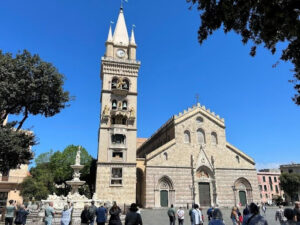 In the Sicilian coastal port of Messina, another legend emerged revering Saint Nicholas as a patron of sailors and fishermen. The story proceeded: “Returning from a pilgrimage to the Holy Land by sea, a mighty storm threatened to wreck the ship. Bishop Nicholas calmly prayed in the midst of the tempest. The terrified sailors watched in amazement as the wind and waves suddenly calmed, sparing them all.” This bishop was orphaned young, yet his legacy came from helping those in need. Awe of this patron resonated with us as we followed our guide, Sofia, into town.
Strolling into the heart of the historic center, we arrived at Cathedral Square. Craning our necks, we contemplated the grand 60-meter bell tower. Home to the world’s largest and most complex mechanical clock. Sofia mentioned that the movement was limited but brilliantly constructed by the Ungerer firm of Strasbourg in 1933. We expectantly waited. At noon, the spectacle began. Bronze automata stirred to life. A roaring lion, crowing rooster, and biblical scenes unfolded in motion. The soaring, graceful notes of Schubert’s Ave Maria wrapped around us. A true “mechanical theatre” that blended science and art.
Afterward, we crossed the square in search of a quaint eatery. Our guide graciously ordered drinks and pastries for us. Granitas came first, consisting of cold, sweet, crystalline flakes. Mine was swirled with strawberry bits, and my son’s with blended coffee. Then they brought out cannoli prepared correctly, where the filling is piped fresh into a crispy shell. We were told, “A cannolo needs to be eaten right away”. Biting into the crisp, bubbly exterior, the creamy sheep’s milk ricotta squished out. Some things are meant to be messy.
Crotone: The Beauty of Wandering
 Crotone, a neighboring port city, greeted us with the ever-changing colors of the Ionian Sea, fading from pale blue to a deep emerald green. Getting on a bus, we were dropped off in Old Town. Our excursion voucher said “on your own”, and we wondered how this qualified as a tour. In hindsight, this day was one of our favorites! The area is compact, making it easy to explore. Tickets for tastings and sights were handed out along with a map marked with “must-sees”. We unfolded our map to see the lay of the land, then ignored it. Getting lost is part of the adventure. Meandering through narrow cobblestone streets, laundry flapped on lines crisscrossing above us. A quiet choreography of daily life. On a terrace nearby, a broom swished. Somewhere else, a voice called out, followed by laughter. We happened upon an open door and discovered we were at the Santa Chiara church, a recommendation by Viking. Stepping inside, we were welcomed by cool air, worn stone, and silence that felt held rather than empty.
Climbing to the top of the hill, the 16th-century Charles V Castle stood watch over the sea. An interpretive guide dressed as the Greek philosopher Pythagoras beckoned us inside. From the tower, we glimpsed the Viking Mars floating in the distance on a field of sparkling light. Below, we descended into the damp chill of the underground prison. Gloomy stories remain confined within that fortified complex.

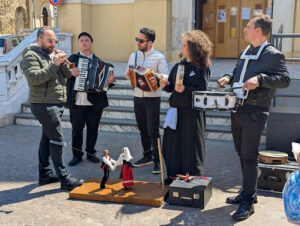
Outside, the somber mood evaporated instantly as we headed downhill toward the wheeze of an accordion, the jangle of a tambourine, and a guitar weaving melody. We followed the sounds to a group of street performers. The flutist controlled puppets by tapping his foot, with their strings attached to his leg. They danced to the voice of his flute. Listening, we stood off to the side with a lemon granita in one hand and sugar clinging to our lips from a soft, warm ciambella fritta. Viking knew exactly what we would enjoy on a warm day. Travel doesn’t always need a headline moment. Sometimes, it’s simply about being present.
Šibenik: Winds That Shape a Life
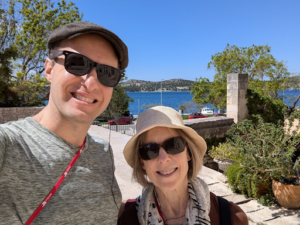 Gazing out over the sea, we learned how to say Šibenik, located in Croatia, as SHEE-beh-neek. And there, standing guard at the sea entrance to St. Anthony Channel, the triangular 16th-century St. Nicholas fortress named after the bishop of Myra, assessed all who dared enter Šibenik. Three additional fortresses, St. Michael, St. John, and Barone, overlook the town like silent stone sentinels.

Walking toward town, the wind arrived before the explanation. Insistent, curling around fortress walls, tugging at our hats. Our guide, Danielle, smiled as if greeting an old friend. “This is Bura,” she said. In Šibenik, wind is not just weather, it’s a language. Bura sweeps down from the northern mountains cold, dry, and unrelenting. Roads and ferries often close during excessive gales. Yet it clears the sky, sharpens the horizon, and salts the land. Prosciutto dries in its presence. Cheese deepens in flavor. A sense of mental clarity comes from the clear air. We took deep breaths and inhaled the pristine air.
Then comes Jugo from the southeast. Warm, humid, lingering. Jugo slows everything. Conversations stretch. Plans dissolve. Locals blame it for migraines, bad moods, and lack of concentration. They even have a word for surrendering to it, “fjaka”. A state of doing nothing. Šibenik folks embrace this relaxed, slow pace of life, where rushing is despised when Jugo winds blow. We contemplated the nugget of truth found in this perspective.
Pompeii: Frozen In Time
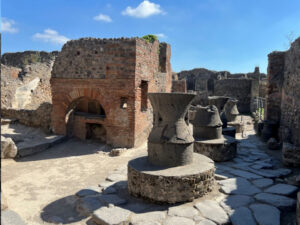 We stepped into Pompeii as if crossing a threshold between breath and stillness. Cobblestone streets stretched ahead, worn smooth by footsteps that ended too soon. We were astounded by the unparalleled look into daily Roman life in a typical middle-class town of 20,000. Locating ovens where bakers baked bread and stores where merchants peddled their wares, we also strolled past fast-food counters. Food once simmered in those terracotta jars, pork, fish, and lentils. And always hot spiced wine.
Crossing the street, we took three giant steps like leaping frogs, on massive, raised stones to avoid walking through wastewater and sewage that once flowed down the roads. Upon entering a residential home, we noticed tiny tiles forming gorgeous mosaics at our feet. The frescoes still clung to walls in reds and ochres that refused to fade. We wondered how things were so well preserved.
In 79 AD, the mountain spoke. Mount Vesuvius suddenly erupted, sending a cloud of ash, dust, and rocks 12 miles into the sky. Settling like dense wet snow, everything stopped within three days. Weight collapsed roofs and floors. All but 2000 residents had fled. A fatal decision when the red-hot pyroclastic flow buried the city under 30 feet of volcanic debris.
The ash that crushed Pompeii also preserved this town. Almost 1800 years later, excavations revealed something extraordinary. Archaeologists detected hollow spaces in the hardened volcanic ash left by decomposed victim bodies. In 1860, Giuseppe Fiorelli developed a technique to preserve the Pompeiians’ final moments by gently filling these voids with liquid plaster. Creating figures. Not statues. Hand holding a cloth over mouth, folds of togas, straps of sandals, a body curled up, expressions frozen in time. Each provided a deeply human look at the disaster. We didn’t linger for long but held the moment in reverence. Some stories ask to be witnessed, not explained.
Naples: Energy, Flavor, and Tradition
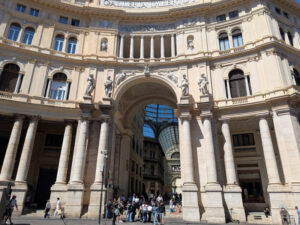 Heading north from Pompeii to vibrant Naples, we immediately sensed the city’s energy. Crowds pressed in with the hum of the city. Vendors hawking their wares convinced me to purchase a small crossbody. We wandered into the grand neoclassical Galleria Umberto I, a UNESCO site. Sunlight poured through the metal-and-glass dome, pooling across marble floors. Only then did we realize that the Teatro di San Carlo across the street, the oldest and most prestigious opera house in Europe, was the landmark we originally set out to find. Instead, we found both, stunning but different.
Tucked inside the shopping arcade is Café Vergnano. Vittoria, our guide, invited us to take a break. The hustle and bustle faded away. People here take time to enjoy little moments. Stopping for espresso, we stood up as we sipped with friends in true Italian style. Then came sfogliatella. Layer by flaky layer, giving way to a warm ricotta infused with citrus and cinnamon. It demanded our full attention. Every bite told a story passed down through generations.
On our way back to the ship, we paused by Castel Nuovo, enormous even from a distance. This medieval Renaissance fortress has five round towers united by impenetrable stone walls. Built primarily of yellow tuff, this detail captured our attention. We learned that pyroclastic rock remains flexible during earthquakes. Naples has about 2,900 quakes on average per year, yet this massive castle has withstood them all.
At Sea Again: What Remains
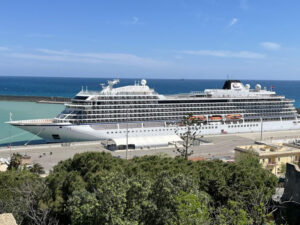 Back on board, the rhythm shifted. We reflected. Saint Nicholas now felt real, woven into the stories, legends, fortresses, and people we encountered. December 6th, Saint Nicholas Day, will forever remind us of this journey and the quiet power of generosity.
That evening, we stepped into the ship’s Kitchen Table for a cooking class. Chef hats on, aprons tied, and knives in hand, we crushed garlic beneath our blades. Between sips of rosé, we prepared lamb and spices for the grill and mixed a sauce to pour over fresh fish fillets. A smile, then spontaneous laughter as Chef Tal taught us secrets of his trade. Cooking became more than instruction; it became a bond.
There is a quiet magic in learning Italian ways through exploration, food, and conversations that stretch long past the table. We arrived expecting to see new sights, taste new cuisine, and learn new skills. We left with something far more lasting. Inspiration and a deep sense of connection. Italy is not just a place on a map. We found it is a feeling – warm, generous, and unmistakably like home.
Pamela Lovegren captures travelers’ imaginations, inspires an enthusiasm for travel, and helps readers envision their next journey. Her experiences range from resort management, leadership conferences, property management, and business consulting to extensive traveling and travel editor of the Well-Traveled Pen. Pamela enjoys celebrating and encouraging women of 50+ who desire to live life with spirit and passion each day.
LivingBetter50 is a magazine for women over 50, offering an over 50 magazine free download for women of spirit!


3 thoughts on “Italian Sojourn on an Ocean Cruise”
A wonderful article Pamela, filled with history and experiences that ignite a passion to go!
Thank you Pamela for including me in your travel journey. what fun to be able to share the trip with your son. Take care.
I could feel, see, hear and almost taste the different aspects of your amazing trip! Thank you for sharing in such detail about the history, culture and traditions in all the areas you visited!
Blessings your way, until the next fantastic trip!