
By Dorothy O’Shea –
It took a positive result on a colon cancer screening test for me to get serious about my health.
Don’t get me wrong. I’m a runner and a vegetarian, so it wasn’t my lifestyle I was worried about. In the months leading up to my 50th birthday, doctors piled on recommendations for medical tests I suddenly needed. In addition to the yearly mole check, mammogram and diabetes tests, a colonoscopy was now on my to-do list– it was overwhelming.

Could the entry into a new decade in my life really make a difference in all these aspects of my health? Turns out in one realm, for me, it did.
Experts recommend men and women begin testing for colorectal cancer at age 50, earlier for those with a prior or family history of the disease or precancerous polyps. According to the American Cancer Society, colon cancer is the second leading cause of cancer-related deaths in the United States.
Age was, by definition, the only reason I needed to care about colon cancer. I thought “the odds are stacked in my favor.” The highest risk factors for colon cancer include smoking, being overweight or obese, having a diet with a lot of red meat and having a family history of the disease. African Americans and Jews of Eastern European descent are also at increased risk. None of these risk factors applied to me.

Still, as my 50th birthday neared, I began dreading all of the medical tests on the horizon, including colon cancer screening. I reluctantly came around to the idea of getting screened after speaking with a close friend who himself had been diagnosed with colon cancer at age 52. He urged me repeatedly to get screened. A month after my 50th birthday, I took the first step and talked with my primary care doctor about my options. As she only recommended colonoscopy, I met with a gastroenterologist for a frank discussion about what my options really were. I told him I didn’t like the thought of a procedure that involved anesthesia and I dreaded the preparation. The gastroenterologist perhaps sensed the fear – if not the staunch refusal – and suggested alternatives.
We discussed alternatives to colonoscopy and I agreed to take an at-home stool-based screening test called Cologuard. It wasn’t an invasive procedure and my gastroenterologist felt that it was the best non-invasive option for identifying cancer and pre-cancer. A non-descript white box arrived at my doorstep via UPS on a Friday. A few days later – with no special diet or attention paid to my colon other than a routine emptying – I shipped the plain white box back with a stool sample.
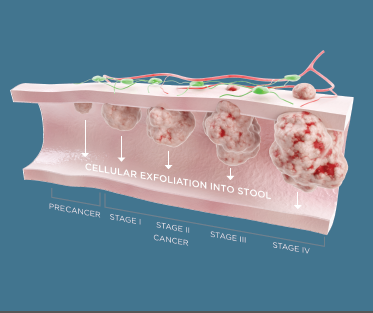
A couple of weeks later I got the call from my doctor. The test, which looked for the presence of blood and analyzed the DNA in my stool, found altered DNA that could be caused by cancer or precancerous polyps in my colon. There was one way to confirm. At that point, my fear of having a colonoscopy was overshadowed by the need to take charge of my body.
I now had a good reason to undergo the procedure, which ultimately detected a quarter-sized tumor. Surgeons removed the tumor, along with my sigmoid colon and 17 lymph nodes.

Overall rates of colon cancer are decreasing, in part because of the availability of non-invasive tests, but also because of those of us who have pushed past our reluctance to get screened. Additionally, a joint effort between the American Cancer Society and the Centers for Disease Control and Prevention is trying to make wider screening methods available to the one third of adults older than 50 who have yet to be tested. The goal of the coalition created by both organizations is to get 80 percent of Americans screened for colorectal cancer by 2018. I’ve done my part.
Early detection of what doctors called stage 1 cancer saved me from radiation and chemotherapy to treat my cancer. The homework on my end to find out what my screening options were was worth minimizing additional cancer treatments and any issues that may have lingered on the back end (pun intended).
Persistence from my friend John (pun NOT intended) who championed the importance of getting screened paid off for me. Now, I intend to be that persistent friend, not only to those I know, but also to you. Be informed, be proactive, get screened and live better.
 As a runner and yoga practitioner, Dorothy is a 50-year old account and lives an active, vegetarian lifestyle and never thought that she would be at risk for colon cancer. Dorothy lives in Marlborough, Mass.

