
By Amandah Tayler Blackwell –
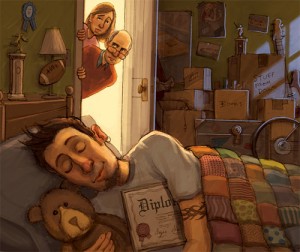
What happens when adult children and their family (pets too) move back home because of divorce, separation, health issues, or job loss? How do you handle the strain of them moving back home? I conducted and Q&A with a couple of experts. Below are tips to help you live with your adult children.
How to Cope When Adult Children Move Back Home

Setting ground rules and deadline to move out
According to Michael Harmann, MSW, “The answer to this question depends on the circumstances and person. Is there an addiction issue? Does the adult child have a history of being dishonest, inconsiderate? How much will the adult child’s return impact the parent’s lives? There are so many relevant variables that affect this important part of the process. Regardless of the adult child’s specific issues, we must learn how to survive and take full responsibility for ourselves. The regression of moving home indicates that the functioning of the adult child has diminished to a point where parents are faced with the tough decision to step in and make up the difference or not.”
Sharon Gilchrest O’Neill, Ed.S., LMFT says, “It’s so important to begin right at the beginning, which is actually even before an adult child moves back home. Have talks; a meeting might sound too formal, but you do want to be formal about the boundaries. A deadline should definitely be discussed in terms of you understanding what your child might have in mind. This is a question to be directly asked so that you can judge the situation.”

Parents must establish and set ground rules before adult children move home. Otherwise, the living situation will become uncomfortable for everyone in the home.
How do you avoid becoming a permanent babysitter for your grandchildren?
Neale Godfrey tells parents, “Be honest about what you’re willing to do and how long you think you can fill-in. If you are not sure, again be honest and say that you will do this for 2 weeks and check back to see how it is going.”
Michael encourages parents to speak up and say, “I’m not watching your kids today. I have a life! Why do you feel so comfortable making your children my responsibility?” He also believes “grandparents are a gift to children because they have the same level of love for the child but less attachment to what the child does or does not do.”

The bottom line is that grandparents have their own lives and shouldn’t be expected to put their lives on hold because their adult children are at a crossroads. Adult children shouldn’t assume their parents will be more than happy to watch their kids. After all, they still have a life.
Finding support
According to Sharon Gilchrest O’Neill, Ed.S., LMFT “Support can be found in self-help books, a counselor or therapist, and importantly with your husband (you two need to be a team on this) or others already living in your home.”
Michael Harmann, MSW, says, “I suggest that parents’ in this situation seek out a therapist that they can see together for the purposes to processing their needs as individuals and as a couple. Many fights can arise from dissent surrounding disagreement with the right move for “our kid.” Blame get thrown around, fingers pointed. Parents are wise to move toward forgiving themselves for the mistake they believe they have made in the past that contribute to the adult child’s current predicament and dysfunction.
Support is all around you. Confide in close family and friends and seek counseling if you must. Don’t think you can handle this situation alone because it could be more stressful than you realize.
How to have the “It’s time to move out” talk
“The topic or conclusion shouldn’t be a surprise, especially if there’s been an appropriate amount of communication and boundary setting,” Michael Harmann, MSW.
“Discuss honestly your needs, financial, emotional and otherwise. Express your empathy and understanding about their situation. Ask how you might be helpful now in other ways. Maybe you will have a short list of possibilities to offer up,” Sharon Gilchrest O’Neill, Ed.S., LMFT.
Neale Godfrey says, “You must set the parameters as soon as they move in. You have a right to know their plans. Explain that it may be an economic burden, or even an emotional situation that you didn’t count on. Just tell them that you love them, but you (and they) were not counting on this—let’s work it out!”
Recap
- Set and enforce ground rules.
- Join a support group.
- Create a contract which outlines information such as the splitting of household expenses, estimated move out date, etc.
- Ask your accountant if you can ‘claim’ head-of-household if your adult children have been living at home for one year or more.
About the experts
Michael Harmann, MSW (Graduate of Columbia University), is a behavioral consultant and works with parents and kids of all ages as well as “Failure to Launch” type clients. He’s based in Weston, Connecticut and offers services nationwide. Visit www.adolescentbehavioralconsulting.com to learn more about Michael.
Sharon Gilchrest O’Neill, Ed.S., LMFT, is a marriage and family therapist/consultant in Westchester, NY, who has been in private practice for over twenty years. She is the author of A Short Guide to a Happy Marriage and Sheltering Thoughts About Loss and Grief. She can be contacted through her website, www.ashortguidetoahappymarriage.com.
For over 30 years, Neale Godfrey has been a recognized expert on family and children’s finances, appearing on Oprah Winfrey, The Today Show, Fox Business, CNN, and The Nightly Business Report (PBS). Recently, Neale has been recognized by Garden State Woman with their Financial Literacy Award. Visit http://www.childrensfinancialnetwork.com/ to learn more about Ms. Godfrey and her work.
Amandah Tayler Blackwell is a freelance and ghost writer for industries such as travel, magazine publishing, real estate, the arts & entertainment, pets, and more. She’s passionate about traveling, art, writing, staying fit, and advocating for animals, children, and the environment. Her website: http://savvy-writer.com/.


3 thoughts on “A Parent’s Guide to Living with Adult Children”
I really enjoyed Ms. Blackwell’s post because right now I’m going through everything she wrote about. I’m 66-years-old, and this is what’s happening in my life right now? I have two adult daughters, one grandson, two cats, one kitten, and two dogs in my home. My granddaughter comes stays at my home when she comes home from college. I have a full house. I want my life back to the way it was … by myself!
I found this article intriguing, particularly so as I had just published a post today addressing adult childen who return home with their children, and seem to have suggested somewhat of a softer response when it came to determining end dates and such (I linked to your article–you can see mine at http://wp.me/p22afJ-L6). You raise an interesting point that I never thought of, however, when you recommend looking into possible addiction issues as part of the problem. Food for thought, indeed.
@ Pat … It may be time for you to tell your daughters how you feel about the situation. Keeping your feelings bottled up isn’t healthy. If you feel you can’t speak to your daughters, write both of them a letter. Say what you want to say in the letter. It’s up to you if you give them the letters or tear them up.
@ Candida … Thanks for linking my article.
I think every situation is different. Some adult children may take advantage of parents if they know which ‘buttons’ to push. Unfortunately, some people use manipulation to get what they want. If an adult child moves home, and mom and dad are doing everything, they won’t be motivated to better themselves. I see this in my own family. My mom’s 66-years-old and is fed up with my older sister. However, my mom won’t speak her truth and tell my sister how she really feels. This isn’t good for either of them.
By the way … My mom has friends who children were born with disabilities or developed cancer (Hodgkin’s) at a young age. These adult children rock! They own their own businesses, homes, and cars. Why? Their parents knew they could be, do, and have whatever it is they wanted out of life. But that’s the key. Their kids knew what they wanted out of life and went for it, and their parents believed in them. Sure, they were probably scared, but they went for the gold and got it. They didn’t settle where they were. They didn’t allow the opinions of others (includes family) to get them down.
It would behoove adult children to reflect on their lives. I recommend starting with childhood. I believe if people were more ‘awake’ than what they are, they’d see the ‘family patterns’ that have been repeated throughout the generations. They’d see the self-sabotaging behavior that occurred over and over again. But most people won’t do this. Why? Because it could mean it’s time for them to move on from their families. I like what Joel Osteen says, “Some people may be for you, and others will be against you. Don’t allow ANYONE to hold you back.” This includes family.
Final thoughts
I know parents do the best they can. Let’s face it; most people don’t grow up in happy homes where everything is “peachy keen.” The majority of people aren’t fortunate enough to have grown up in a family like those portrayed on TV. But people can choose to change themselves. They can choose to do better. They can choose to forgive their parents because their parents were once children; they did the best they could. But, instead, most people will have a pity party versus looking in the mirror and taking responsibility for their life. Believe me; looking in the mirror isn’t easy. I know because I’ve done this. The freedom you receive from taking responsibility for your life and choices is priceless. I’m glad I did it.